

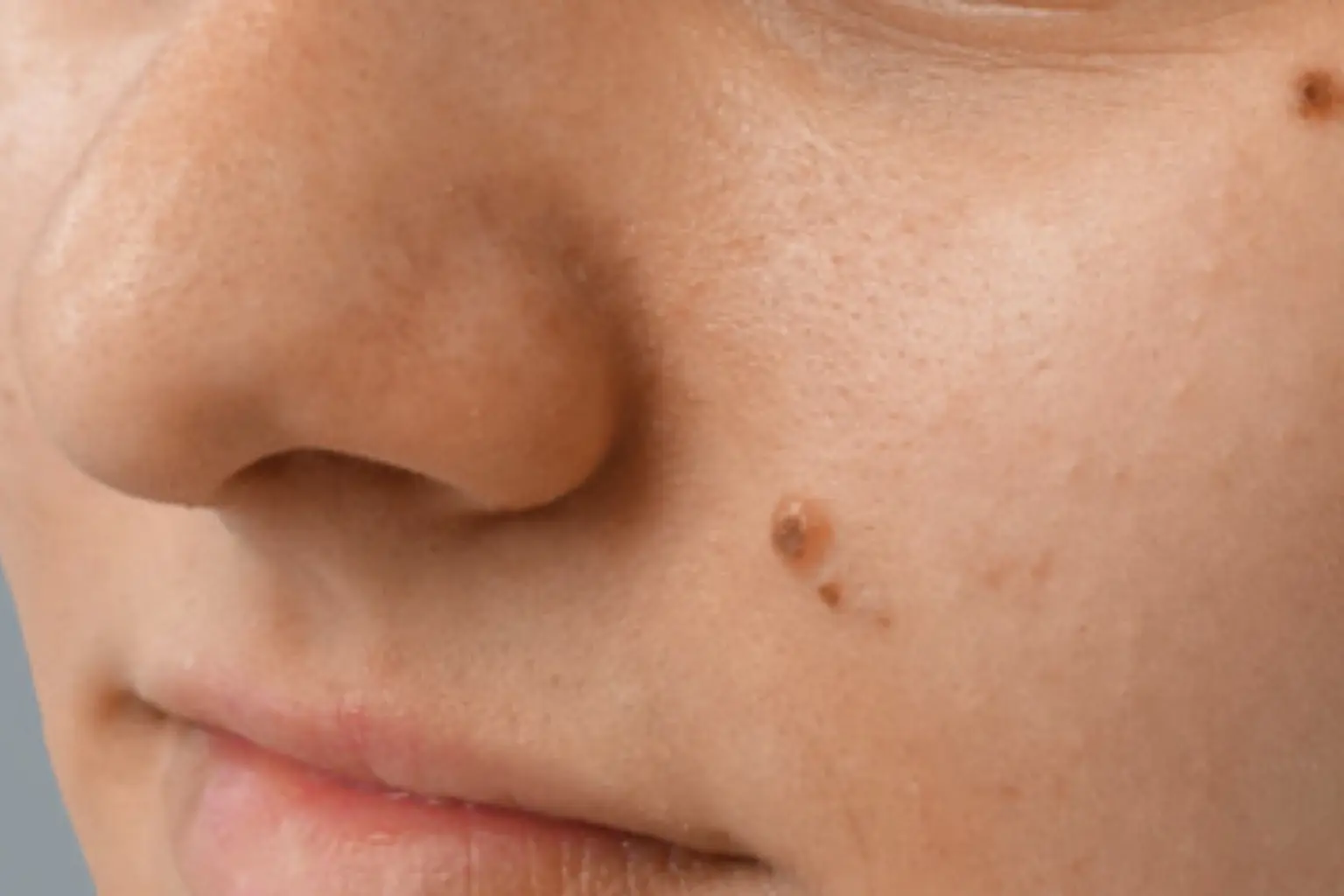
Two Different Ways a Mole May Be Removed
Patients researching cosmetic mole removal often come across two terms: surgical excision and shave excision. They are not the same procedure, and they create different types of wounds and scars. In my practice, I use surgical excision rather than shave excision for cosmetic mole removal. The reason is not simply preference. It is related to how completely the mole is removed and what type of scar may remain.
What Is Surgical Mole Excision?
With surgical excision, the mole is removed through an incision and the skin edges are brought together with sutures. The incision is planned according to the mole, surrounding skin and the direction in which the final scar is expected to sit most favourably. This produces a linear scar that is usually slightly longer than the original mole. The trade-off is clear: the mole is replaced by a planned line that gradually matures over time.
What Is Shave Excision?
Shave excision removes the raised portion of a mole without removing the full depth of the lesion. The wound is generally left to heal without the same type of linear sutured closure used in surgical excision. A shave can sound appealing because it may seem like a smaller procedure. However, the shape of the resulting wound and the amount of mole tissue left beneath the surface are different from a full surgical excision.
Why Does Dr. Ho Not Routinely Use Shave Excision?
I do not routinely use shave excision for cosmetic mole removal because there is a greater possibility of the mole recurring and the resulting scar can sometimes develop a depressed or irregular contour. For patients seeking cosmetic removal, I prefer surgical excision so that the mole and the resulting scar can be managed in a more controlled way.
Does Surgical Excision Mean a Bigger Scar?
It generally means a longer linear scar than the width of the mole. That does not automatically mean the scar will be more noticeable in the long term. Scar appearance is affected by the direction of the incision, skin tension, anatomical location and individual healing. The important point is to understand the expected scar before choosing a technique rather than assuming that the smallest initial wound will always create the least noticeable final mark.
Can a Mole Come Back After Removal?
Recurrence is one reason technique matters. If mole tissue remains, pigmentation or a raised component can become visible again later. No procedure should be described as guaranteeing that a mole can never recur. The appropriate discussion depends on the type of mole and the way it is removed.
Is the Mole Sent for Pathology?
Not every cosmetic mole removed in my practice is automatically sent for pathology. Depending on the appearance of the mole and the clinical circumstances, removed tissue may be sent for pathology. A mole that is changing in a concerning way should not simply be approached as a cosmetic lesion. Increasing size, colour change, bleeding, pain or another suspicious change warrants medical assessment before cosmetic treatment.
Which Technique Is Right for You?
Technique should not be chosen from a website description alone. The size, depth, location and appearance of the mole, as well as the scar you would be accepting in exchange for it, all matter. For the cosmetic moles I treat, surgical excision gives me the ability to remove the lesion and deliberately plan the closure and final scar.
Written and medically reviewed by Dr. Adelyn Ho, MD, MPH, FRCSC
Plastic and Reconstructive Surgeon
Last reviewed: September 2026
