

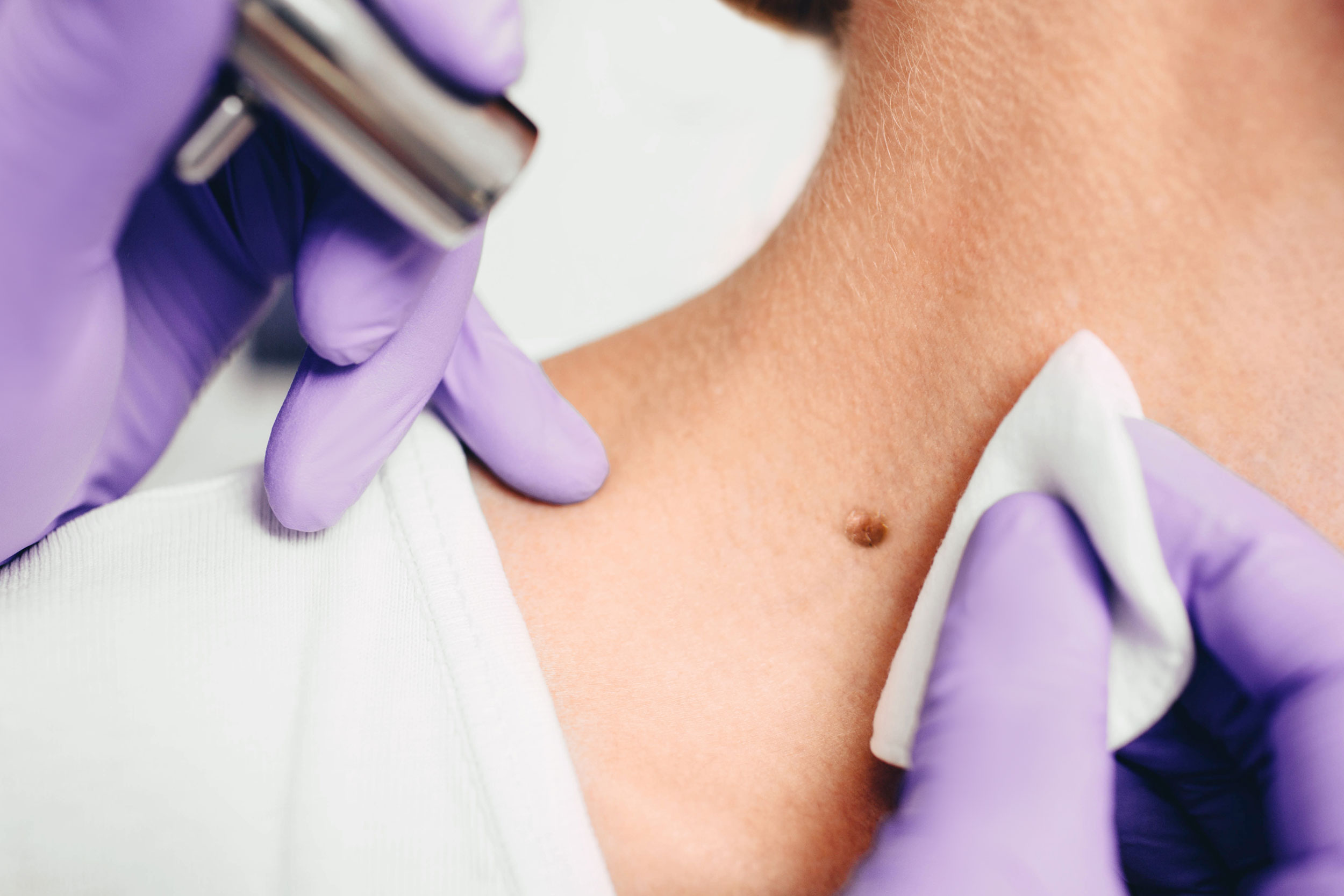
What Will the Scar Look Like After Mole Removal?
One of the most important things to understand before cosmetic mole removal is that the mole is being exchanged for a scar. There is no truly scarless way to surgically remove a mole.
That does not mean the scar will always be more noticeable than the mole. For many patients, the goal is to replace a pigmented or raised spot with a fine linear scar that becomes less obvious as it matures. Whether that trade-off is worthwhile depends on the mole, its location and how you feel about it.
Why Is the Scar Longer Than the Mole?
When a mole is removed with surgical excision, the skin needs to be closed without creating puckering or excessive distortion. This generally requires an incision that extends slightly beyond the width of the mole.
The final scar is therefore usually a straight line that is somewhat longer than the original mole. This is something I discuss before surgery because the length and direction of the scar are part of the decision, especially on the face.
Where Is the Incision Placed?
Scar planning depends on the treatment area. Where possible, I position the incision within a natural crease or along a relaxed skin tension line so that the scar sits in a direction that is less conspicuous as it matures.
The options are different on the cheek, chin, forehead, neck, trunk and extremities. A scar also behaves differently in an area that moves frequently or carries more skin tension.
What Does the Scar Look Like Early On?
Early scars are often much more obvious than patients expect. The incision may look pink or red and can sometimes appear more pigmented than the surrounding skin. It may also feel firm, raised or bumpy during the early healing phase.
This early appearance is not the final result. Scar tissue changes gradually, and the line generally softens and fades over the following months. Improvement can continue throughout the first year.
Do Facial Mole Removal Scars Heal Differently?
Facial scars are often the main concern because they are difficult to hide. At the same time, facial skin can heal very well when the incision is appropriately planned and cared for.
The exact result still varies. Mole size, skin characteristics, scar location, tension, individual healing and previous treatment all matter. No surgeon can promise that a facial mole-removal scar will become invisible.
What Scar Care Does Dr. Ho Recommend?
Scar care is individualized according to how the incision is healing. Once the wound has healed sufficiently, scar management may include silicone tape or silicone gel.
For facial moles, makeup can usually be worn at approximately two weeks to help conceal the scar while it continues to mature. Your specific instructions should take priority because timing depends on the incision and healing.
When Should I Judge the Final Scar?
Not at two weeks, and usually not at two months. A scar is biologically active for many months. Early redness, firmness and contour change can gradually settle. If you are considering mole removal for cosmetic reasons, it helps to make the decision knowing that the early scar may temporarily be more noticeable than the mole you removed.
The Most Important Trade-Off
Cosmetic mole removal is not simply about whether a mole can technically be removed. The better question is whether the expected scar is an acceptable trade for the mole that is currently there. During your consultation, I look at the mole, its location and the direction of a potential scar and discuss that trade-off before you decide whether to proceed.
Written and medically reviewed by Dr. Adelyn Ho, MD, MPH, FRCSC
Plastic and Reconstructive Surgeon
Last reviewed: August 2026
