

LESION PROCEDURES
Cyst Removal in Vancouver
A skin cyst is a sac that develops beneath the skin and may gradually increase in size. Cysts are usually benign and may remain painless for years, although they can become uncomfortable, inflamed, infected or begin to drain. Two common types are epidermoid cysts, often referred to as sebaceous cysts, and pilar cysts, which commonly occur on the scalp. Not every lump beneath the skin is a cyst, and not every cyst needs to be removed. An assessment can help determine what the lump is and whether surgical removal is appropriate.
Procedure Overview
| Procedure time | Usually a short office procedure; exact time varies with cyst size, location, depth and closure complexity |
| Anaesthetic | Local anaesthetic |
| Initial recovery | Several days of mild tenderness or swelling may occur; wound and suture care depend on the treatment area |
| Return to work | Many patients return to non-strenuous work and routine activities relatively quickly |
| Exercise | Heavy exercise is generally avoided for approximately one week or as directed |
| Scarring | A permanent linear scar remains after excision and gradually matures over time |
| Cost | A personalized quote is provided after assessment; cyst removal starts at $800. |
Why Do Patients Consider Cyst Removal?
The decision to remove a cyst depends on its location, size, symptoms, history and clinical appearance. Many cysts can simply be observed. Patients commonly consider removal when a cyst:
- is gradually getting larger
- causes discomfort or pressure
- repeatedly becomes inflamed
- has recurrent drainage or odour
- catches on clothing, hair or equipment
- creates a visible or bothersome lump
- has returned after previous drainage
Is Cyst Removal Right for You?
| Cyst removal may be appropriate if | Another approach or evaluation may be more appropriate if |
| You have a stable skin or scalp lump that is clinically consistent with a cyst. | The diagnosis is uncertain, the lump is rapidly changing, or another type of lesion needs to be ruled out. |
| The cyst is growing, uncomfortable, repeatedly draining or bothersome. | The cyst is small, stable, painless and not bothersome, so observation may be reasonable. |
| The cyst is not acutely inflamed or infected at the time of elective excision. | There is active infection or marked inflammation that may need treatment before definitive removal. |
| You understand that complete capsule removal lowers but does not eliminate recurrence risk. | You expect simple drainage to provide the same long-term result as complete excision. |
| You understand that surgical removal leaves a permanent scar and can follow wound-care instructions. | A medical condition, medication, nicotine use or wound-healing issue should be optimized before elective removal. |
Sebaceous and Epidermoid Cyst Removal
What many patients call a sebaceous cyst is often an epidermoid cyst. These cysts contain keratin within a lining or capsule beneath the skin. They may remain stable for long periods or gradually enlarge. Some become inflamed, tender or begin to drain. When definitive removal is appropriate, the goal is to remove not only the cyst contents but also the surrounding cyst wall or sac.
Pilar and Scalp Cyst Removal
Pilar cysts commonly occur on the scalp. Patients may notice a firm lump beneath the hair that gradually becomes larger or becomes uncomfortable when brushing or styling their hair. Larger scalp cysts can also separate surrounding hair follicles and make the contour more noticeable. Scalp cysts can usually be removed surgically under local anaesthetic when appropriate. Because the scalp behaves differently from other areas of the body, closure and postoperative care may also differ. Pilar cysts often feel firmer and more rounded than epidermoid cysts, but clinical assessment is still important because not every scalp lump is a pilar cyst.
Cyst Drainage vs Complete Cyst Removal
This is an important distinction. Draining a cyst releases its contents but generally leaves the cyst lining or sac behind. Because that lining remains, the cyst can refill. Surgical cyst excision aims to remove both the cyst contents and the capsule. Removing the capsule as completely as possible lowers the likelihood that the same cyst will return, although recurrence can never be completely eliminated.
When Is the Best Time to Remove a Cyst?
A cyst is generally easier to remove completely when it is not actively inflamed, draining or infected. Inflammation can make the cyst wall more difficult to separate from the surrounding tissue. If a cyst is acutely inflamed or infected, treatment of the inflammation or infection may need to occur first, and definitive removal may be delayed until the area has settled. In some situations an infected cyst itself requires surgical treatment, so timing depends on the individual clinical situation. Previous rupture, infection or drainage can also create scar tissue around the cyst, make subsequent removal more complicated and increase the chance of recurrence.
How Is a Cyst Removed?
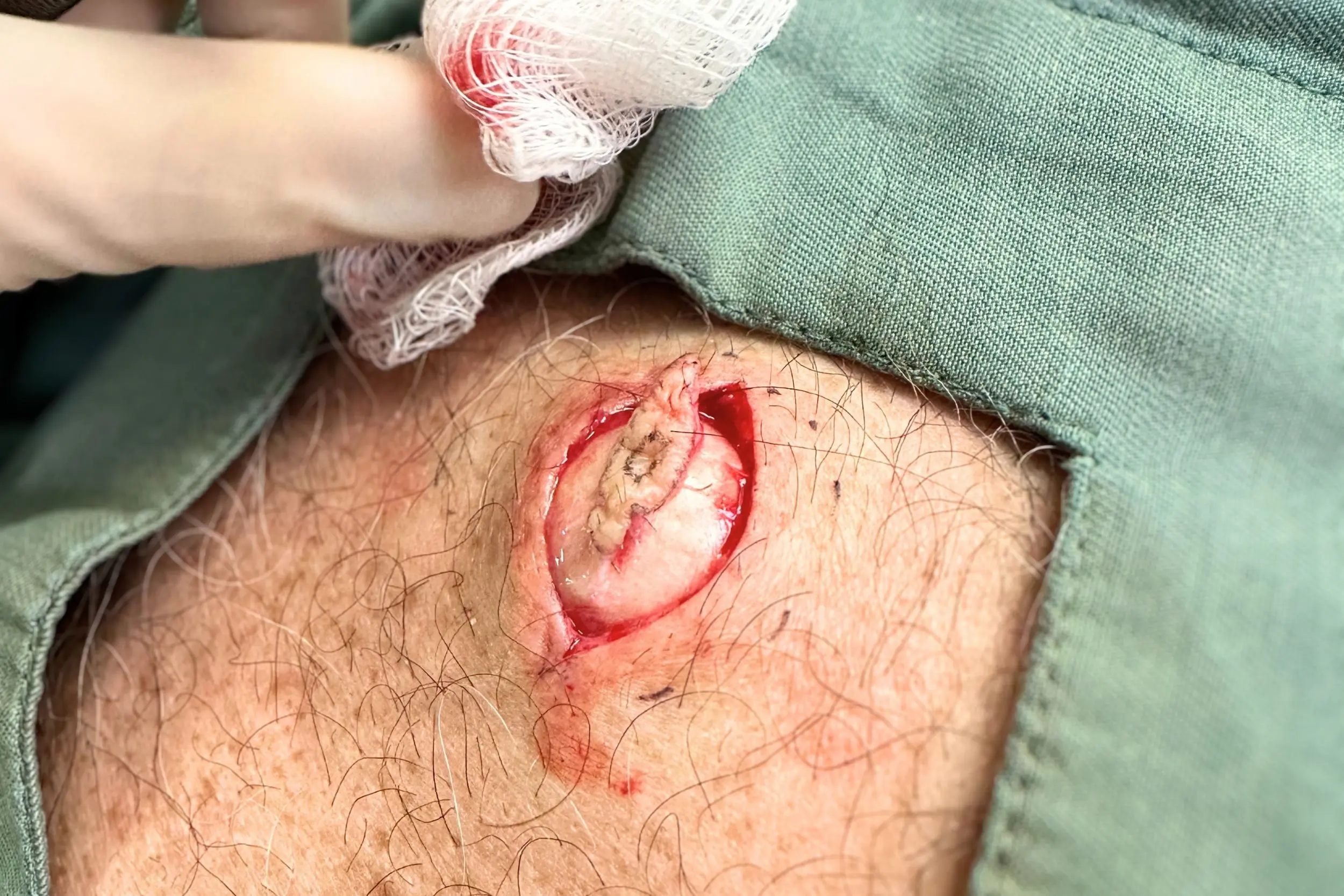
For appropriate cysts, removal is performed under local anaesthetic while you are awake. The skin is numbed and an incision is made over or near the cyst, depending on its size and location. A small opening or punctum may sometimes be visible on the skin and can be included with the excision when appropriate. The cyst sac is carefully separated from the surrounding tissue with the goal of removing it as completely as possible. The incision is then closed with sutures. The size and location of the cyst, previous inflammation and the amount of surrounding scar tissue all influence the incision and closure required.
Will Cyst Removal Leave a Scar?
Yes. Surgical cyst removal requires an incision and therefore leaves a permanent scar. The appearance of the scar depends on the location and size of the cyst, skin tension, previous inflammation or infection and how the individual patient heals. Previous drainage, rupture, inflammation or infection can make dissection and closure less predictable because of surrounding scar tissue.
As a plastic surgeon, Dr. Ho considers the incision, tissue handling and closure as part of the treatment plan. The goal is not a “scarless” procedure, but a carefully planned removal and closure followed by appropriate scar care.
What Is Recovery Like After Cyst Removal?
Recovery depends on the cyst location and the type of closure required. Many patients can return to normal non-strenuous activities relatively quickly. Heavy exercise is generally avoided for approximately one week so that unnecessary tension is not placed across the incision. Depending on the treatment area, some external sutures may be removed at approximately five to seven days, while other areas may be closed with absorbable sutures. Scalp cysts are often managed differently, and absorbable sutures may gradually loosen and fall out over approximately two to three weeks. Specific wound care, activity and scar instructions are provided after the procedure. For more detail about wound care, stitches, exercise and healing, read Cyst Removal Recovery: Stitches, Exercise and Aftercare.
How Much Does Cyst Removal Cost in Vancouver?
The cost of cyst removal depends on the size and location of the cyst, whether it has been previously inflamed or treated, and the complexity of the removal and closure. Cyst removal starts at $800, depending on the treatment plan. These are starting prices and costs could vary depending on the complexity of each patient’s case. A formal quote will be provided to you at your consultation.
Can a Cyst Come Back After Removal?
Yes, a cyst can recur, although the chance is lower when the entire cyst capsule can be removed. Recurrence may be more likely when a cyst has previously ruptured, become inflamed or infected, or been drained, because scar tissue can make the capsule more difficult to separate completely. Occasionally, a new cyst may develop beside a previous cyst-removal site. This does not necessarily mean that the original cyst has returned. Some patients develop multiple cysts, and a smaller nearby cyst may not have been apparent when the original cyst was removed. Less commonly, epidermoid cysts can also develop in areas of previous trauma or surgery.
Why Choose Dr. Adelyn Ho For Cyst Removal
- Royal College-certified plastic surgeon with experience in surgical removal and soft-tissue closure.
- Personalized lesion assessment that considers the history, location, size, symptoms, previous inflammation and whether the clinical appearance is consistent with a straightforward cyst.
- Scar-conscious surgical planning with attention to incision placement, tissue handling, closure tension and the expected location of the final scar.
- Clear wound-care, activity, suture and scar-management guidance, with close follow-up care.
Frequently Asked Questions About Cyst Removal
Is a sebaceous cyst the same as an epidermoid cyst?
The term “sebaceous cyst” is commonly used by patients, although many of these cysts are actually epidermoid cysts.
Is cyst removal painful?
Local anaesthetic is used to numb the treatment area. You may feel the local anaesthetic injection and some pressure or movement during the procedure, but the area should be numb during removal. We recommend taking Advil and Tylenol shortly after the procedure.
How long do stitches stay in after cyst removal?
Suture type and timing depend on the treatment area and closure. Some external sutures may be removed at approximately five to seven days, while body incisions may use absorbable sutures. Scalp closures may use absorbable sutures that loosen gradually over approximately two to three weeks.
How are scalp cysts different?
Many scalp cysts are pilar cysts. Their location around hair follicles and the characteristics of scalp skin affect both the surgery and the type of closure used. Pilar cysts often feel firmer and more rounded than epidermoid cysts.
When can I exercise after cyst removal?
Heavy exercise is generally avoided for approximately one week, although this depends on the cyst location, incision and individual healing.
Considering Cyst Removal in Vancouver?
If you have a skin or scalp lump that may be a cyst, a consultation can help clarify the diagnosis, whether removal is appropriate, and what to expect in terms of scarring and recovery. If you have already had an ultrasound of the area, please bring the report to your consultation. In some cases, we may recommend ultrasound before assessment depending on the size, location or characteristics of the lump.
Prefer to contact us directly?
604-806-3650 | info@dradelynho.com
Medically reviewed by Dr. Adelyn Ho, MD, MPH, FRCSC | Plastic and Reconstructive Surgeon | Last reviewed: August 2026
